CloudHealth vs Hypermeter
CloudHealth by Broadcom is broad and action-oriented: native coverage of AWS, Azure, Google Cloud and Oracle Cloud, rightsizing and reservation management, optional policies that can stop or terminate resources, and a partner platform for MSPs that rebill public cloud. Hypermeter is the choice when the allocation has to stand up when someone challenges it, when you want a tool that never acts on your infrastructure, from an independent EU vendor hosted in the EU, or when private infrastructure beyond vSphere needs to be metered and rated alongside the cloud.
Hypermeter is built by Exivity, which also makes Exivity Core, a metering and billing engine that runs in your own environment — relevant if you also need to meter private infrastructure or bill external customers, which CloudHealth does not do.
Exivity is an independent EU company with no investors outside the EU; no cloud provider, hyperscaler or reseller owns it. Hosted entirely within the EU or run in your own environment, it is built to meet SEAL-3 (digital resilience) of the EU Cloud Sovereignty Framework.How sovereign deployment works →
Claims about CloudHealth were checked against their public documentation on 2026-10-08. If something has changed, tell us and we will correct it.
At a glance
Capability | CloudHealth | Hypermeter |
|---|---|---|
Cost visibility across AWS, Azure and Google Cloud | ✓ | ✓ |
Allocation with an explicit unallocated bucket | ✓ | ✓ |
Allocation traceable to its weights and source rows | Partial: percentage and proportional reallocation; no documented line-item audit trail | ✓ |
Budgets by team | ✓ | ✓ |
Forecasts with a stated method and error history | Partial: ML forecasts; no published error history | ✓ |
Unit economics with revenue joined | Partial: cost-per-unit trends; no documented revenue join | ✓ |
AI and token cost | ✓ | ✓ |
VMware vSphere cost | ✓ | ✓ |
Nutanix, OpenStack and bare metal metered | – File upload only | ✓ |
Rate usage with tiered or contract pricing | Partial: AWS price books with markups, discounts and fixed rates; no tiers | ✓ |
Billing end customers | Partial: public cloud only | ✓ |
Rightsizing and commitment management | ✓ | – |
Automated actions on your resources | ✓ Optional: read-only by default | – Never, by design |
EU-hosted option | – Not documented | ✓ |
Self-hosted or air-gapped | – | ✓ with Exivity Core |
What CloudHealth does that Hypermeter doesn’t
It can act on your cloud, not only report on it. If you enable them, CloudHealth’s policies can start, stop or terminate instances on AWS, Azure and Google Cloud, on their own or after an approver signs off, and Savings Automator manages AWS convertible reservations. Its rightsizing covers the three big clouds and vSphere. Hypermeter has no actions on your infrastructure and will not change anything you run.
It manages commitments. CloudHealth has dedicated reservation and Savings Plan management for AWS and Azure. Hypermeter does not manage commitments and will not exchange or purchase them for you.
Its connectors are built in. CloudHealth connects natively to AWS, Azure, Google Cloud and Oracle Cloud, takes Alibaba Cloud bills by upload, runs a collector in your Kubernetes clusters, and costs vSphere in its data centre module, all without configuring a source. In Hypermeter, each source is set up against its own export or API.
It has deep multi-level access control. FlexOrgs give up to ten levels of organisational units with inherited roles, built for holding companies and MSPs with many tenants.
Where Hypermeter is the better choice
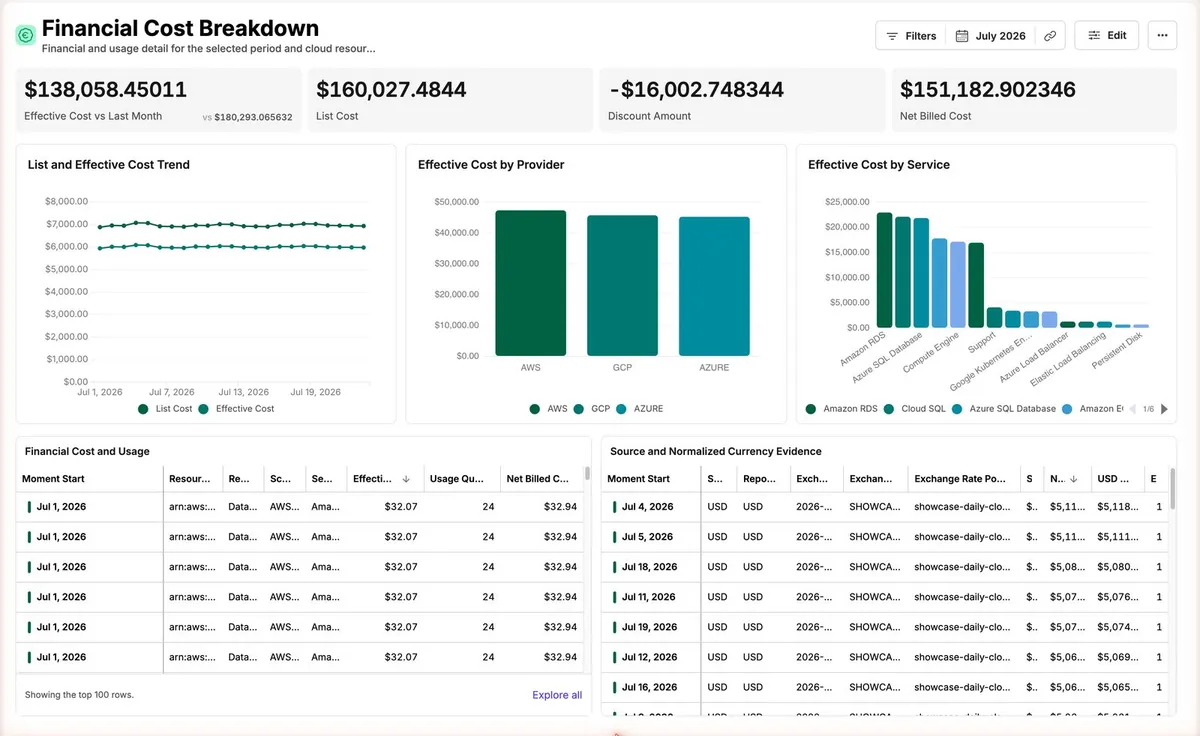
The number will be challenged and you have to answer. CloudHealth’s Perspectives assign each asset to a group by rule, and shared cost moves through percentage or proportional reallocation. Hypermeter’s allocation is a pipeline you can read: shares weighted by a measure you choose, allocated rows that sum exactly to the group total, and the weights and remainders kept as evidence. When a team disputes its share of a shared platform, you open the calculation and show the rows behind it.
You want a cost tool that never acts on your infrastructure. Hypermeter has no actions: it will not resize, schedule, stop or reconfigure anything, and its connections read data with credentials you issue. Whether a cost vendor may change production is a real question in many organisations. For teams whose answer is no, a tool that cannot act is simpler to approve than one where actions are a setting away.
Ownership and data residency are part of the decision. CloudHealth has had three owners since 2018, and Broadcom documents it as SaaS only, with hosting in the US, Germany and the UK on its sub-processor list. Exivity is an independent EU company with no investors outside the EU. Hypermeter is hosted in Germany, and Exivity Core runs in your own environment, including air-gapped, where your data policy needs it.
Private infrastructure goes beyond vSphere. CloudHealth costs vSphere in its data centre module; anything else arrives as a file you build. Hypermeter pulls usage from the platform’s own API, whether that is vSphere, Nutanix Prism, OpenStack or Redfish on bare metal, without waiting for a predefined connector. It rates that usage at the rate you set, or one you derive from capital, facilities and support cost, and the result sits in the same model as the cloud bill. Hypermeter runs as SaaS, so the API has to be reachable from it; where it is not, Exivity Core meters on-site.
You need to know how the forecast was made. CloudHealth forecasts with machine learning and publishes no error history. In Hypermeter, a forecast is a calculation in your own pipeline, so its method, training window and error history can be published alongside it, and anyone who checks can see how the number was made.
The differences that decide it
Act on the cloud, or explain it
This is the biggest split. CloudHealth is built to find savings and, where you allow it, take them: rightsizing, reservation management, policies with actions. Hypermeter is built to attribute cost to whoever caused it and to defend that attribution. Decide whether a cost tool that can change production is a feature or a risk in your organisation, and the shortlist gets shorter.
How an allocation is explained
Both products keep cost they cannot place visible, rather than hiding it. The difference is what sits behind a team’s number. In CloudHealth it is the rule that put an asset in a group, and the reallocation that moved shared cost. In Hypermeter it is a calculation in your own pipeline, with its weights and remainders kept as evidence. If chargeback disputes are a monthly event, ask both vendors to walk one disputed charge back to its source, on your data.
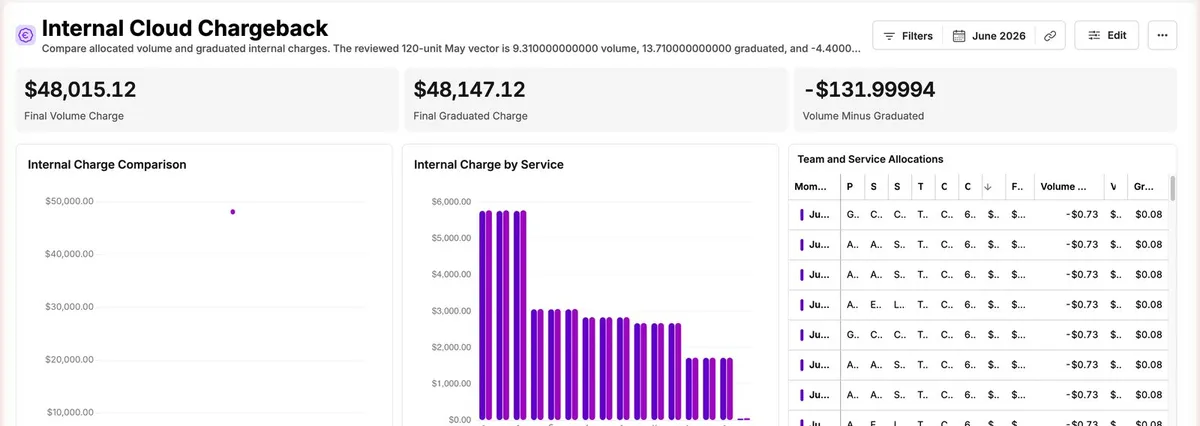
Where private cost comes from
CloudHealth’s data centre module collects vSphere resources and prices them by benchmark or by cost drivers you set. Other platforms come in as uploaded files. Hypermeter reads usage from any platform API it can reach and rates it in the same model as the cloud, with tiered, graduated or contract rates, or a rate derived from what the infrastructure costs to run. That matters most for organisations mid-migration, where cost per workload on each side of the boundary is the business case for moving it.
Service providers
CloudHealth’s Partner Platform bills end customers for AWS, Azure and Google Cloud, with price books, markups and statements; custom price books are AWS only. Hypermeter rates each customer’s usage, cloud and private infrastructure alike, with tiered, graduated and contract pricing, and reports margin per customer. For the invoice itself, Exivity Core produces invoice-ready output, keeps a rate card per level of a reseller hierarchy, and runs self-hosted. The difference is scope: private infrastructure on the same invoice as cloud, and billing that runs in your own environment.
Migration and coexistence
CloudHealth and Hypermeter can run side by side, and during a migration they should. Both read the same billing exports from your own cloud accounts, so nothing has to come out of CloudHealth before you start. Moving means re-expressing Perspectives as a Hypermeter model. Expect to gain an allocation you can trace and a tool that never acts on your infrastructure; expect to lose rightsizing, reservation management and automated actions.
Before you leave CloudHealth: the checklist
Write these down before you sign with anyone, including us.
Contract. Renewal and notice dates, and what the contract says about getting your data out.
Allocation logic. Every Perspective and its rules, your FlexOrgs, and how tags map to teams. The part you do not want to rebuild from memory.
Reports people open. Not every report you have. The ones finance and engineering open each month. Ask them.
Alerts and policies. Budgets, anomaly alerts and governance rules, and who receives each one. Note which policies take actions.
Commitments. How reservations and Savings Plans are tracked, and who decides on purchases.
Integrations. API consumers, SSO, BI exports, and any custom data fed in from outside the cloud bill.
Customer billing. For service providers: price books, markups, and the rules behind each customer statement.
History. How many months you need for forecasts and audits, and where the raw billing exports sit in your own cloud accounts. Export the CloudHealth reports you need for audit, through FlexReports or the API, before the contract ends.
In detail
Criteria | CloudHealth | Hypermeter |
|---|---|---|
Category | Multi-cloud cost management and FinOps platform, part of Broadcom’s software portfolio | FinOps platform for metering, allocating and reporting on cloud and IT spend |
Allocation | Perspectives: rule-based groups, with an “Assets not Allocated” bucket and percentage or proportional reallocation for shared spend; FlexOrgs for multi-level access | Allocation by measured weight; allocated rows sum exactly to the group total, with weights and remainders kept as evidence; unallocated cost kept as its own line |
Unit economics | Cost-per-unit trends; cost per 1M tokens on the AI & Tokenomics dashboard | Ratio and weighted measures on any unit you define, with revenue joined at the grain you choose |
Forecasting | ML forecasts for AWS, Azure and Google Cloud, trained on 1 to 12 months of history, up to 36 months ahead | Forecasts calculated in your own pipeline, published with their method and training window |
Data sources | AWS, Azure, Google Cloud and Oracle Cloud natively; Alibaba Cloud by bill upload; Kubernetes collector; Data Connect for Databricks, OpenAI, Anthropic and CSV or Parquet files | Any REST API, SQL database (PostgreSQL, MySQL, MariaDB, SQL Server, Oracle) or object store (S3, Google Cloud Storage, Azure Blob), as CSV, JSON, NDJSON or Parquet |
On-prem and virtualisation metering | VMware vSphere through the data centre module, costed by benchmark or by cost drivers you set; other platforms as uploaded files | Usage pulled from platform APIs such as vSphere, Nutanix Prism, OpenStack and Redfish, then rated at a rate you set or derive from capital, facilities and support cost. Hypermeter is SaaS, so the API must be reachable from it; Exivity Core meters on-site where it is not |
Optimisation and automated actions | Rightsizing for AWS, Azure, Google Cloud and data centre; reservation and Savings Plan management; Savings Automator for AWS convertible reservations; optional policies that can start, stop or terminate resources | No rightsizing actions, no commitment management, and no actions on your infrastructure |
Billing external customers | Partner Platform: bills end customers for AWS, Azure and Google Cloud, with price books, markups, discounts and statements | Rated charges per customer, cloud and private infrastructure alike, with tiered, graduated and contract pricing; invoice-ready output from Exivity Core |
FOCUS | Generates a FOCUS 1.2 dataset (Broadcom notes known gaps) | Reads FOCUS exports as CSV or Parquet, and models data to the FOCUS specification |
Deployment and data residency | SaaS only. Broadcom’s sub-processor list names hosting in the US, Germany and the UK; we found no EU-only option documented | Multi-tenant SaaS, hosted in Nuremberg, Germany; Exivity Core runs self-hosted, including air-gapped |
Ownership | Broadcom, since it acquired VMware in November 2023; VMware acquired CloudHealth Technologies in 2018 | Exivity, an independent EU company with no investors outside the EU |
Pricing | No public pricing | No public pricing; priced by quote |
Frequently asked questions
The questions buyers ask when CloudHealth is on the shortlist, in the words they use.
Ask us about your use caseIs Hypermeter a CloudHealth alternative?
Yes, for cloud cost allocation, chargeback and unit economics. Hypermeter, built by Exivity, adds allocation you can trace, a tool that never acts on your infrastructure, EU hosting from an independent EU vendor, and metering and rating of private infrastructure through each platform’s API. It does not offer rightsizing, reservation management or automated actions on your infrastructure.
CloudHealth vs Exivity Core: which should I compare?
Compare CloudHealth with Hypermeter for FinOps. Compare CloudHealth’s Partner Platform with Exivity Core if you are a service provider: both bill end customers, and Exivity Core also meters and invoices private infrastructure and runs self-hosted.
Does CloudHealth cover on-prem?
Partly. CloudHealth’s data centre module covers VMware vSphere, priced by benchmark or by cost drivers you set. Other private infrastructure comes in as files you upload. Hypermeter pulls usage from platform APIs such as vSphere, Nutanix Prism, OpenStack and Redfish and rates it. Where those APIs cannot be reached from the cloud, Exivity Core meters on-site, including air-gapped environments.
Can I move my Perspectives to Hypermeter?
Not by import. Each Perspective is re-expressed as rules in a Hypermeter model. Write down every Perspective, its groups and the rules behind them first, then run both side by side and compare.
How long does migrating from CloudHealth take?
It depends on how many Perspectives you rely on and how many sources you have. Ask for the time to the first allocated report on your own data.
Will I lose my historical data?
Hypermeter reads the provider’s billing exports from your own cloud accounts, so history goes back as far as those exports do. Check how many months you have before you start, and export the CloudHealth reports you need for audit before the contract ends.
Which is better for MSPs?
CloudHealth’s Partner Platform rebills AWS, Azure and Google Cloud. Hypermeter rates public cloud and your own infrastructure per customer on the same terms and reports margin. Exivity Core adds invoice-ready output, a rate card per level of a reseller hierarchy, and billing that runs in your own environment.
Which is cheaper?
Neither publishes prices. CloudHealth is sold through Broadcom and its partners; Exivity prices Hypermeter by quote. Price both on your own estate.
See it on your own data.
A demo scoped to your question, run by an engineer. Bring one cost source and leave with a recommendation.